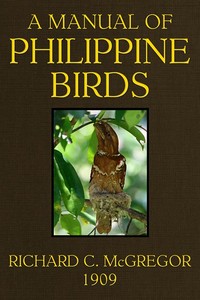
A Manual of Philippine Birds by Richard C. McGregor
Let's be clear from the start: this isn't a novel. A Manual of Philippine Birds is exactly what the title says—a scientific manual. Published in the early 1900s, it was the first comprehensive guide to the birds of the Philippine Islands. Richard McGregor, an American ornithologist, compiled descriptions, classifications, and details about the habitat and distribution of hundreds of species. He worked from collected specimens, creating a systematic reference that organized a chaotic slice of nature into a usable catalog for scientists and enthusiasts.
The Story
The 'story' is one of discovery and meticulous work. Picture McGregor at his desk, surrounded by bird skins and notes from across the archipelago. Each page introduces a new bird: the fiery red plumage of the Rufous Hornbill, the delicate shape of a fantail, the powerful build of a monkey-eating eagle. He gives each one a name, measures its wingspan, notes where it lives, and often shares a small, observational detail that brings it to life. The narrative is the slow, careful building of knowledge, island by island, species by species, creating a baseline understanding of Philippine avian life that didn't exist before.
Why You Should Read It
You should read it for the sense of wonder. While the language is technical, there's a palpable excitement in McGregor's careful descriptions. This book is a snapshot of a natural world that was still largely undocumented. It connects you directly to the moment of scientific discovery. It’s also a fascinating historical artifact. You see the science of its time in action, and you gain a deep appreciation for the foundational work that all modern bird guides and conservation efforts in the Philippines are built upon. It makes you look at the birds outside your own window with new respect, knowing someone once had to formally describe them for the very first time.
Final Verdict
This book is a specialized treasure. It's perfect for birdwatchers with a historical bent, natural history nerds, and anyone in the Philippines curious about their ecological heritage. It's not a casual weekend read; it's a book to dip into, to marvel at the illustrations (if your edition has them), and to appreciate as a monumental piece of work. Think of it less as a storybook and more as a museum exhibit you can hold in your hands—a direct line to the pioneering spirit of early natural science.